There are two main approaches to mapping plants. The method you choose depends on your need for precision and your budget, particularly in terms of time, equipment, and technical effort.
For most gardens, the primary purpose of a map is to help staff reliably locate a plant. In some cases, however, such as when map data is used to inform construction, infrastructure planning, or detailed spatial analysis, a much higher positional accuracy may be required.
Using GPS / GNSS receivers
One approach is to record plant coordinates using a GPS or GNSS receiver. Coordinates can be captured directly by the device or manually entered if you are using external equipment that cannot connect to a mobile device.
This method is commonly used when you have access to a high-precision GNSS receiver and require survey-grade accuracy for plant locations.
While this approach can deliver very accurate results, it typically requires more time, specialised equipment, and technical expertise.
Read more about high precision mapping.
Mapping by approximation
The alternative approach is approximation mapping using visual reference points. With this method, plants are positioned by dragging markers into place based on neighbouring plants or visible physical features shown on the map.
This approach can be highly effective, particularly when:
You have a good quality base map, or
Larger or long-lived specimens have already been mapped and can act as anchors.
Approximation mapping is often faster and more practical for day-to-day horticultural and curation workflows.
Mapping beds and plants by approximation
Reference points and hybrid approaches
A hybrid strategy can offer the best of both worlds. For example, surveying all long-lived or significant specimens increases the number of reliable reference points available for approximation mapping.
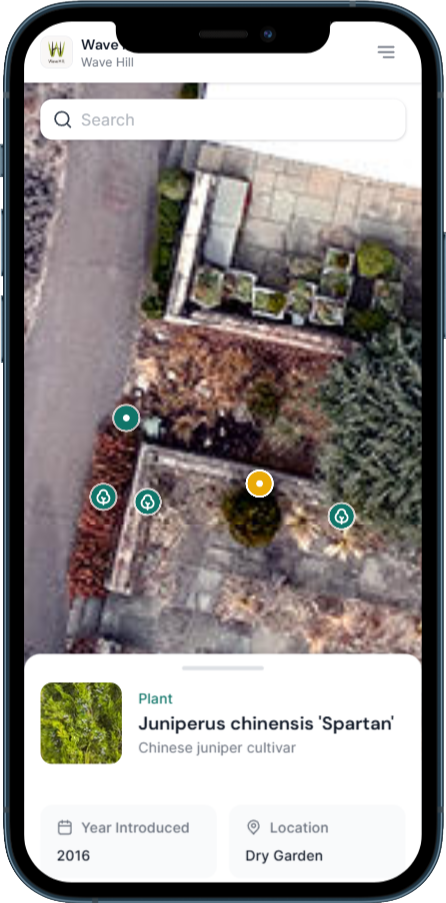
Another option is to commission a drone survey of the garden. Drone imagery typically provides far more detail than publicly available satellite imagery. If you choose this route, it is best to capture imagery before the tree canopy fully develops—such as on a sunny day in early spring when buds are forming, and visibility is highest.
Drone map example
Precision vs accuracy in Botanical GIS
Many GIS and mapping professionals come from a surveying background, where absolute accuracy is often critical. Botanical GIS, however, usually involves a different balance, prioritising efficiency and usability while maintaining sufficient accuracy to locate plants in the landscape.
For example, you can draw a bed in Hortis the size of a coffee table and map dozens of plants within it. The resulting coordinates are highly precise relative to that bed, but they may not be entirely accurate when translated to their exact physical location in the real world.
Understanding this distinction helps set realistic expectations and choose a mapping strategy that best supports your garden’s operational needs.